
Empower your organization.
Design it with AI.
Collectively, time-effectively & valuably.
Just like great products, great organisations are intentionally designed. They're tested, iterated, and constantly refined based on sharp design criteria, feedback and outcomes.
What version of your organisation are you running today? Is it time for a redesign? Not because it is bad — but because the world, your people, and your goals have evolved?
What
Leveraging all available resources
Org charts, job descriptions, MCP connections to key resources, …
Defining your own guidelines for the interviews
Framing script, mandatory and optional questions, closing script and interview techniques — tailored to your project.
Conducting in-depth agentic interviews with all stakeholders
All at the same time if desired, not restricted by resource availability, and with no cost per interview once your project band is selected.
Identifying and eliminating organizational dysfunctions
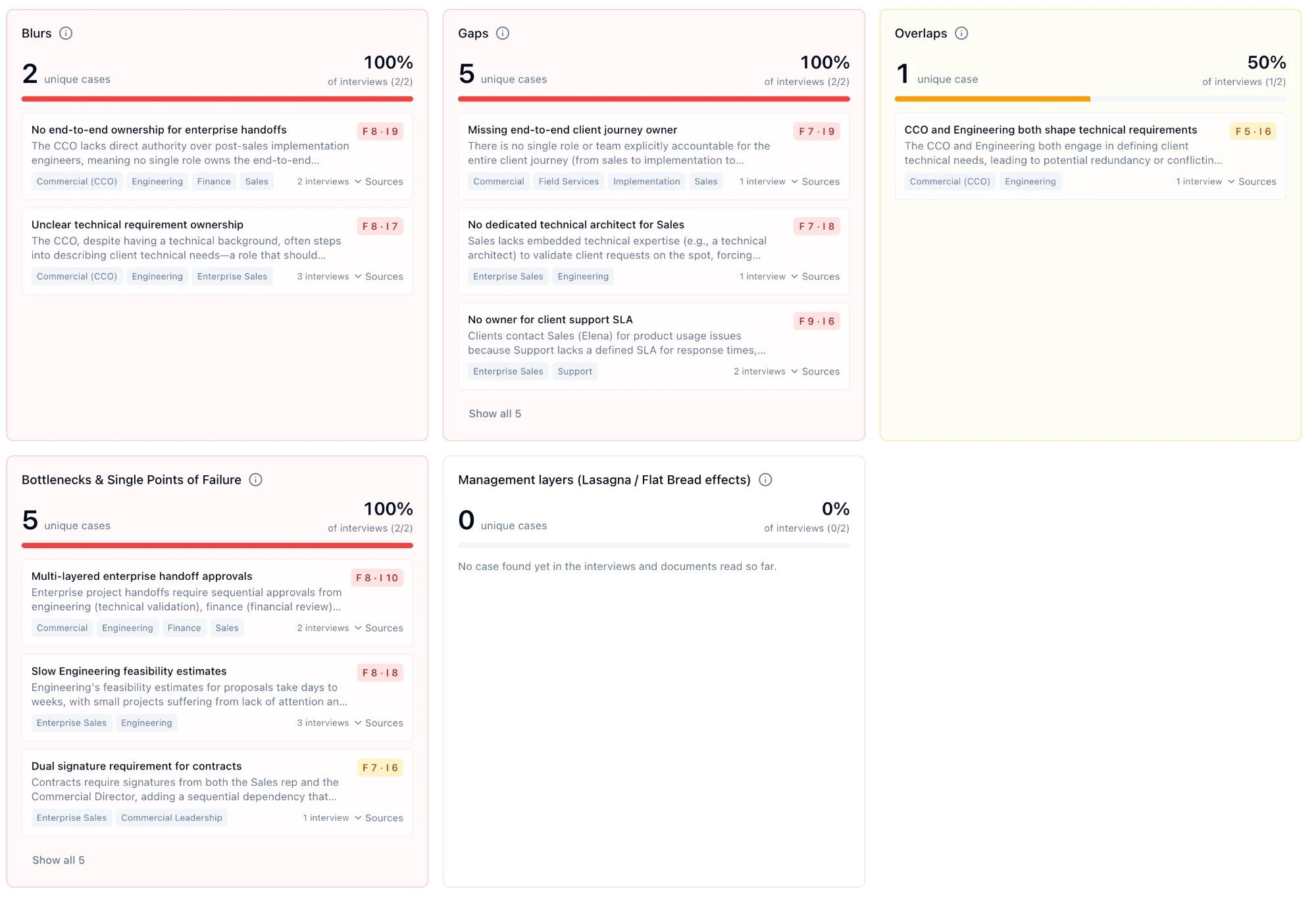
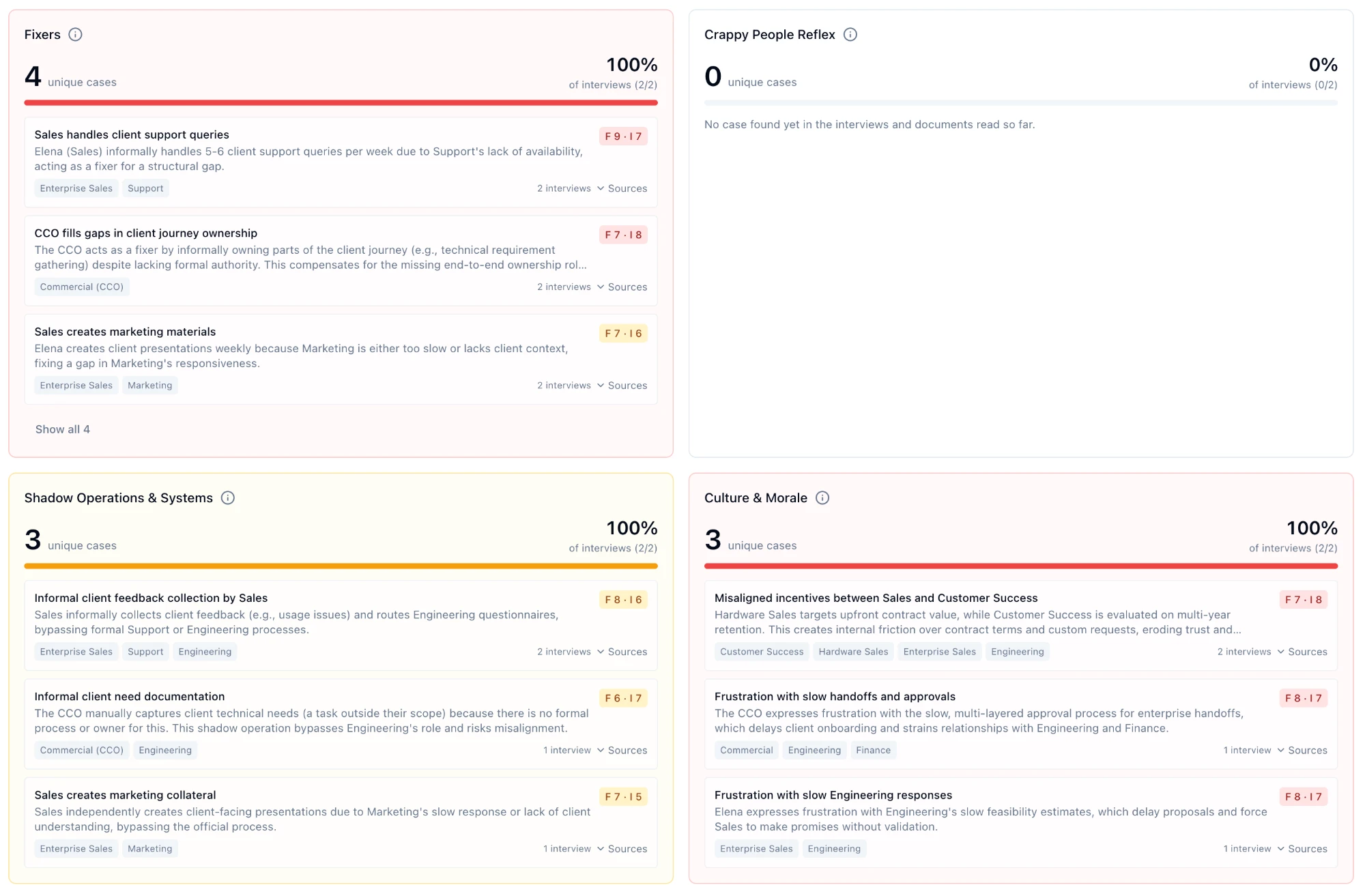
Blurs, gaps, overlaps, bottlenecks, single points of failure, shadow operations & systems, …
Aligning the structure with its strategic objectives
And with its operational characteristics, through explicit design & sorting criteria.
Establishing clear unit assignments
Goals, activities, scope, autonomy level, team requirements, interdependencies, governance requirements and (AI) automation potential.
How
Six phases in a linear flow. Click on a phase to see the details.
Phase 1 Set-up
- Define the scope and the why of the project.
- Grant access to relevant static resources (e.g. organization charts, job descriptions, process flowcharts, …).
- Establish MCP connections with third-party software when desired (e.g. Office 365, Workday, …).
- Establish the team and their roles.
- Approve the budget and the timeline.
- Tailor & calibrate the interview settings, based on our pre-established framework: interview preparation requirements, framing script, questions (mandatory/optional), interview guidelines, closing script, interview techniques, built-in evaluation and trained agent.
Phase 2 Interviews
- Plan the interviews.
- Perform & track the interview preparation.
- Execute the (voice) interviews.
- Review the interviews.
- Provide feedback on the interviews.
- Ask and respond to follow-up questions (when applicable).
Phase 3 Diagnostics
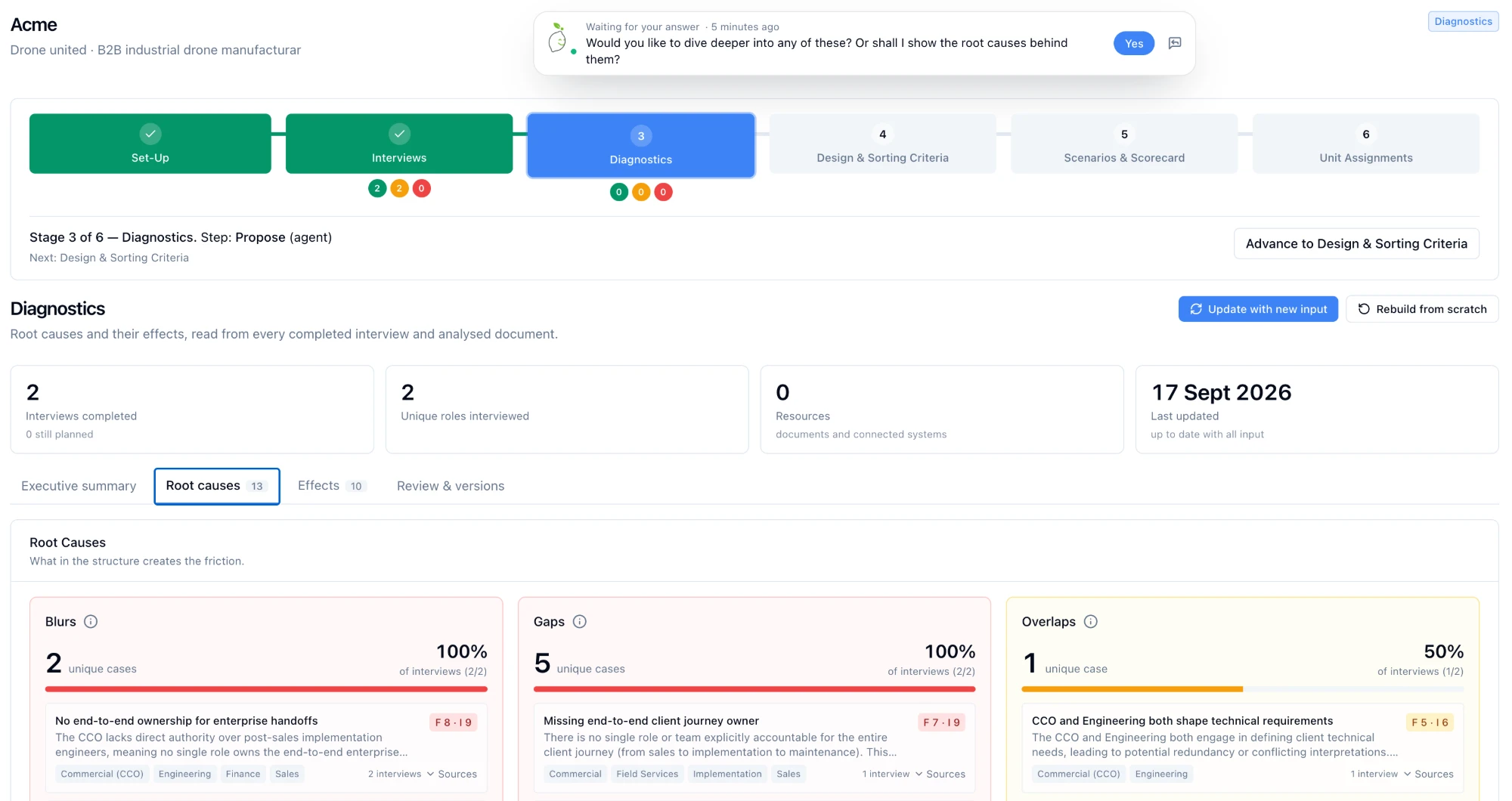
- Extract the information from the interview preparation, the interviews, the static resources and the connections to summarise the key findings into a Dashboard with the Root Causes and Effects.
- Review and fine-tune where needed (Human-In-The-Loop).
Phase 4 Design & Sorting Criteria
Design criteria
- Extract the strategic performance standards (what will make the organization successful?).
- Usually about 5–6 criteria that are not achievable at the same time.
- Identify the actions and behaviour to reinforce/to stop for each criterium.
- Review and fine-tune the criteria where needed (Human in the Loop).
Sorting criteria
- Extract the specific categorical dimensions used to group and divide people and units.
- Category examples: functional groups (purchase, sales, engineering, finance, …), product/service groups, geography, customer segments, degree of variability (low/high), degree of certainty (low/high), perspective/orientation (outside-in, inside-out, outside-in & inside-out), …
- Review and fine-tune the criteria where needed (Human in the Loop).
Phase 5 Scenarios & Scorecard
- Generate 10-15 organizational structure scenarios based on the design & sorting criteria, sorted from incremental to disruptive.
- Score the current organizational structure and the selected new scenarios against the design criteria and provide feedback (Human-In-The-Loop).
- Fine-tune the scenarios, the design and sorting criteria accordingly.
- Select the preferred organizational structure.
Phase 6 Unit Assignments
- Create a unit assignment per unit in the preferred organizational structure.
- For each unit assignment, establish the goals, activities, scope, level of autonomy, team requirements, interdependencies and potential (AI) process automations.
- Review and fine-tune the unit assignments, the preferred organizational structure and the design & sorting criteria (Human-In-The-Loop).
What your free trial includes
- Two interviews — run them yourself or with any stakeholder of your choice.
- Your own documents — load your org chart, job descriptions and/or your own specific interview guidelines.
- Diagnostics & three scenarios — based on the documents provided and the two interviews.
- The scorecard — score your current organizational structure and the three scenarios against the design criteria distilled from your documents and your two interviews.
Why
“We want to be customer centric but are organized by function, each different function being in contact with the customer independently.”
- Without AI — the dysfunction as it exists today
- AI in Operations alone — surfaces and amplifies it
- AI in Operations & the Org Design project — fixes it
Operations — Root Causes
| Indicator | Without AI | With AI in Operations only | With AI in Operations & Org Design |
|---|---|---|---|
| Blurs Role & boundary ambiguity: it's unclear who owns a specific responsibility, outcome or decision, so multiple people touch it inconsistently. | No one really knows who signs off on this, so everyone waits for someone else to move first. | The AI drafted three different versions of the same proposal because it couldn't tell who actually owns the decision. | The required governance and human-in-the-loop points are clearly defined. |
| Gaps Unassigned work & missing capabilities: critical tasks, decisions or strategic capabilities that are completely unassigned to any formal role or team. | Nobody had this on their list until the customer complained, then everyone scrambled. | The AI flagged the gap in seconds. It still took three weeks to find someone to own it. | Every critical capability has an owner, human or agent, before it turns into a fire. |
| Overlaps Redundancy & territorial friction: two or more roles or departments explicitly claim ownership over the exact same task, process or decision rights. | Our customer is sending an urgent request to all the people he knows within our organization and each of us starts to act on it depending on our availability and experience. | Now three of our agents are working the same request in parallel, and none of them know about the other two. | Ownership is unambiguous, so the same request only ever gets picked up once. |
| Bottlenecks & Single Points of Failure Critical reliance on specific people, causing the process to be too slow or to fail. | If she's on holiday, that approval simply doesn't happen. | The AI can draft it in seconds. It still sits in her inbox waiting for the one signature that counts. | Decision rights are distributed, so the process no longer depends on one person being reachable. |
| Inadequate Management Layers “Lasagna effect” — too many hierarchical layers; or “flat bread effect” — a high span of control that overstretches leaders. | My manager is micro-managing. | My manager is freaking out as he/she feels out of control. | The governance of the value stream has been agreed upon, and my manager can review the different activities & decisions independently at any time. |
Operations — Effects
| Indicator | Without AI | With AI in Operations only | With AI in Operations & Org Design |
|---|---|---|---|
| Fixers People who go beyond their role to resolve issues caused by structural gaps — skilled, recognized, and sometimes overloaded by it. | I am making the difference by fixing all the things that fall through the cracks. Some days it is too much. | I am overwhelmed by the speed and the number of possibilities/requests from AI agents. | Thanks to the reduction of gaps in the organization, the clarity in the responsibilities, the involvement of AI in the value streams and the good governance, I don't have to fix the same things again and again. |
| Crappy People Reflex The systemic bias where leadership misattributes structural design failures to individual employee incompetence. | Leadership says the project managers just aren't assertive enough. Nobody asks whether they were ever given the authority to be. | Now they say the team "isn't keeping up with the AI", instead of asking why the process around the AI was never redesigned. | The diagnostic showed leadership it wasn't a people problem. It was a role, process and governance problem. |
| Shadow Operations & Systems Systemic inefficiencies where people bypass official processes and systems in order to function. | I am using Claude on my personal account to gain efficiency at work. | Half the team has its own favourite AI tool by now, and none of them talk to each other or to the official systems. | AI use is part of the official toolkit, so it's visible, governed, and it actually adds up across the organization. |
| Culture & Morale Culture is the enduring system of shared values, beliefs and behavioural norms that dictates "how things get done"; morale is the collective emotional reaction and attitude of employees toward that environment and their work. | We've always solved things this way, so raising it a different way gets you nowhere — and by now, people are tired of fixing the same problem every quarter and getting blamed for it. | Nobody has agreed on how AI is supposed to fit into "the way we do things here", so people quietly adopt it, quietly resent it, or quietly ignore it — depending on who they ask. | The norms for working with AI were agreed together, not imposed, so people trust the process and feel genuinely heard, because everyone was interviewed, not just a sample. |
Org Design Project
| Factor | Without AI | With AI in Operations only | With AI in Operations & Org Design |
|---|---|---|---|
| Time | It takes quite a lot of time to conduct in-depth interviews, perform the analysis, propose solutions and manage the project. | It takes even more time to get a good grasp of how work is being performed, as there are also agentic agents involved in the value streams. | The interviews can be conducted all at once, significantly reducing the throughput time of the project, and the analysis happens continuously as each one comes in instead of waiting for all of them to finish. |
| External Resources | We had to rely heavily on an external organization design consultant to bring in objectivity, coaching, organization design, business process modelling and project & change management skills. | The agents that are now involved in (part of) the value streams cannot be interviewed in the regular way. | The time dependency on the external resource is decreased while the quality of the work and its added value is significantly increased. |
| Budget | The time and external resource requirements are driving up the budget significantly. In order to contain the budget we decided to scope down the project and only interview part of the people, but this had a negative impact on our ability to surface all the dysfunctions and improvement opportunities as well as on engagement. | We're already paying for half a dozen AI subscriptions across the business, and now also for the consultant to work out how it should all fit together. | The efficiency gain allows us to reduce the budget with no cost per interview once your project band is selected. |
| Risk | Doing the project is perceived as risky. The high visibility, high impact on people, high anticipated resistance and uncertain return make it a high risk project. | Not doing the project is risky. | Involving all the stakeholders and leveraging all the available resources is lowering the risk profile of the project and increasing the return. |
Pricing
Priced per project, by the number of people in scope. Unlimited interviews in every band.
Team
Up to 50 people
LaimonTree fixed fee€9,500
Indicative consultant feeConsultant time is not included in the band price. It is billed separately by a certified partner or by the LaimonTree consultant. Prices are indicative and are based on 3 assumed org units.€12,600
Total€22,100
Unlimited interviews
Payment100% at checkout
Department
51–150 people
LaimonTree fixed fee€19,500
Indicative consultant feeConsultant time is not included in the band price. It is billed separately by a certified partner or by the LaimonTree consultant. Prices are indicative and are based on 6 assumed org units.€22,200
Total€41,700
Unlimited interviews
Payment50% before project creation, 50% within 30 days
Division
151–400 people
LaimonTree fixed fee€34,500
Indicative consultant feeConsultant time is not included in the band price. It is billed separately by a certified partner or by the LaimonTree consultant. Prices are indicative and are based on 12 assumed org units.€44,400
Total€78,900
Unlimited interviews
Payment50% before project creation, 50% within 30 days
Enterprise
401–1,000 people
LaimonTree fixed fee€59,000
Indicative consultant feeConsultant time is not included in the band price. It is billed separately by a certified partner or by the LaimonTree consultant. Prices are indicative and are based on 25 assumed org units.€96,000
Total€155,000
Unlimited interviews
Payment40% before project creation, 60% within 30 days
All prices per project, in EUR, VAT excl.
Included in every band
- Unlimited interviews — with everyone in scope.
- All stages — from Set-up to Unit Assignments.
- Intervision tools
- 12 months access
Empower your organization. Design it with AI.
Start with a free test project: two interviews, your own documents, the diagnostics, three scenarios and the scorecard.
Start free trial